The Conference
A Sandia Base trip report by Cdr. Richard S. Mandelkorn first recorded this conference; Tranche 4 now adds the verbatim transcript itself, classified SECRET. The meeting's own subject is "aerial phenomena" over the nuclear installations, and the transcript captures the moment attendees note that the Air Force had just renamed its investigation from Project Sign to Project "Grudge," which, in their words, "includes the phenomena observed in New Mexico." The attendee list is the point, meet the room.
This is not a room of mid-level investigators. It is the institutional core of the American nuclear weapons program, convened in secret, specifically to evaluate unexplained aerial phenomena over its own installations. The same names that appear in the history of the Manhattan Project appear on the distribution list of a UFO investigation.
Until now, that room came to us secondhand, through Cdr. Mandelkorn's trip report. Tranche 4 releases the conference itself: DOE-UAP-D004, the verbatim minutes, classified SECRET and forwarded from Los Alamos on 22 March 1949. The transcript opens with the Army's Captain Neef explaining how the inquiry began: "It all started back in December, 1948, when we first received some reports from some airline pilots that these green fireballs were sighted." He then hands the floor to Dr. LaPaz of the University of New Mexico, the meteoriticist the Army had brought in, to explain why these lights were not falling rock.
LaPaz's case, in his own words, was that the fireballs showed "a very remarkable hue of green, not heretofore observed" in any meteor fall he knew of, that they traveled long, nearly horizontal paths at almost constant brightness, and that on those grounds they "could not be conventional meteorite falls." He was telling the men who had built the bomb that the objects over their own laboratory did not behave like anything in the sky's ordinary inventory. Nothing in the transcript offers a better answer.
Teller's Problem
The co-designer of the hydrogen bomb did what physicists do: he ran the numbers. They pointed away from every conventional answer, and stopped there.
The men who built the bomb, asked to explain the lights
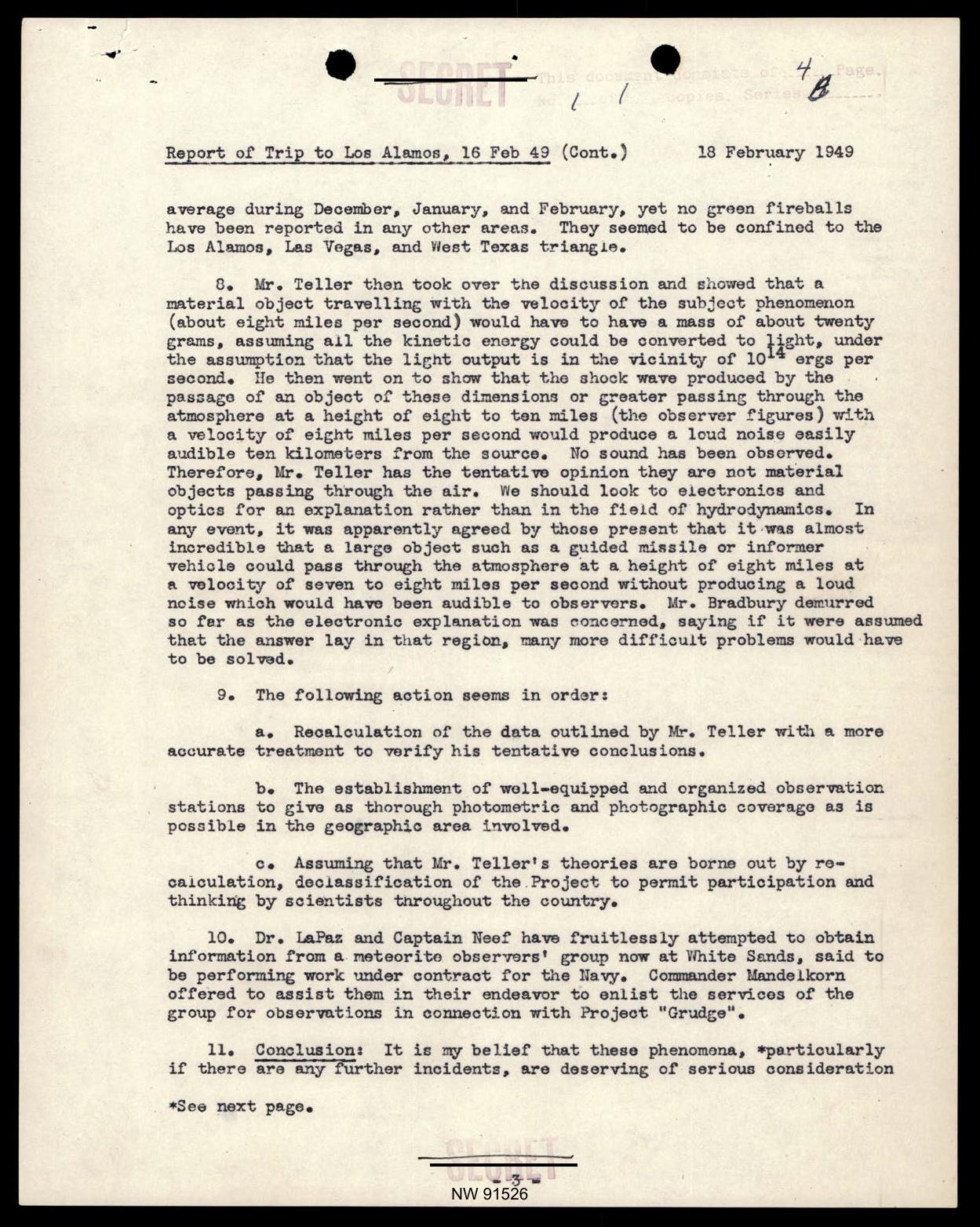
Working from the observed brightness, Teller calculated that a material object producing that much light at the reported speed would generate a shock wave audible ten kilometers away. None had been heard. His analysis pointed away from a foreign missile or aircraft, but produced no explanation of its own.
"Mr. Teller has the tentative opinion they are not material objects passing through the air. We should look to electronics and optics for an explanation rather than in the field of hydrodynamics."
The meeting's standing conclusion was that the phenomenon was real and unexplained, and that its recurrence "in the vicinity of sensitive installations" was cause for concern.
The Physicist's File
The lab's engagement did not end in 1949. A 1970 file shows a Manhattan Project physicist, James L. Tuck, personally gathering green-light reports and reading the government's own UFO study.
James L. Tuck was a British-born physicist who worked on the Manhattan Project at Los Alamos and stayed on through the early fusion era. A 1970 correspondence file released as DOE-UAP-D002 shows him doing something unexpected for a senior weapons physicist: collecting eyewitness accounts of the lights.
One handwritten reply, sent to Tuck in November 1970 by a member of the Los Alamos Protective Force, recalls that "during the years 1948 through 1951, several sightings of green lights were made at Los Alamos," usually between nine and eleven at night, "in the Jemez Mountains," with the lights "weaving in and out of mountain peaks", and one daylight sighting of "five objects flying over Los Alamos … in formation." The writer notes it was "all reported to the Protective Force Headquarters and should be a matter of record on their logs."
A Manhattan physicist, reading the Condon Report
In a December 1970 letter, Tuck writes to the U.S. Army Engineering School requesting the "recipe" for simulated atomic-bomb demonstrations, explaining: "We are interested in the large atmospheric vortices which are produced as reported in the book 'Scientific Study of Unidentified Flying Objects' by Dr. Edward U. Condon." That is the Condon Report, the University of Colorado study, published in 1969, that became the official basis for the Air Force closing Project Blue Book. A separate note in the same file weighs UFO propulsion ideas against Einstein's pursuit of a unified field theory.
The detail that matters: a physicist from the project that built the bomb was, two decades on, still treating the phenomenon as a live technical question, and reaching for the very study the government used to declare the question closed.
The Pattern
Los Alamos is one node in a record that clusters, decade after decade, on the geography of the bomb.
The association predates the conference. In 1947 the FBI preserved a newspaper clipping in which a scientist "who had worked as a researcher on the Manhattan Project" stated plainly that "such flying discs actually are in existence" and added, tellingly, "I have been waiting for someone to tie the discs to Hanford", the Manhattan Project's plutonium-production site. A Manhattan scientist was connecting the sightings to nuclear geography the same year the modern UFO era began.
And it did not end with the founding generation. A 1986 newsletter of the Los Alamos "Pajarito" Astronomers Club, released as DOE-UAP-D003, carries a UFO guest-speaker announcement: a faint signal on its own, but one more marker of the subject's persistence in the same small mesa town, nearly forty years on.
What Tranche 5 added is the other half of the same winter. Three months before Bradbury convened his scientists, the Air Force had already run the problem and failed. In a study of roughly 180 incidents completed in November 1948 (DOW-UAP-D100), Air Materiel Command reported a residue of reports with no everyday explanation, recorded that no physical evidence had been obtained, and stated that the discs, cigar-shaped objects and balls of light were not of domestic origin. In the same compilation it advised against telling the press about the objects it could not identify. So by February 1949 two separate arms of the government had independently arrived at the same place, and neither said so publicly: the Air Force in writing in November, the Atomic Energy Commission in a classified room at Los Alamos in February. The conference on this page is not an isolated curiosity. It is the second of two institutions failing at the same question in the same season, and the first one had already decided the failure was not for publication.
The Control Case
If the green fireballs were a secret American test vehicle, there is one place they should never have appeared.
In late summer 1973, a CIA intelligence report (CIA-UAP-D001) logged a source's observation at a Soviet nuclear facility: "an unidentified sharp (bright) green circular object or mass in the sky." The description is almost identical to the American green-fireball reports of 1948–1949, twenty-four years later, on the other side of the Iron Curtain, at a facility with no conceivable connection to a US black program.
That is the control case. Whatever was clustering over Los Alamos, Sandia, and Hanford was also clustering over Soviet nuclear sites, where no American test program could reach. The pattern is not a property of one country's secrets. It is a property of the phenomenon, and of the bomb.