Sworn testimony, measured against the documents

What Congress put on the record

Between 2022 and 2025, four congressional proceedings moved UAP from rumor into sworn testimony. The newsworthy fact is not what the witnesses claimed. It is that Congress took the claims seriously enough to put specific agencies, programs, and people into the official record under oath. This page asks one question: of what was named, how much can 216 declassified primary-source documents actually corroborate? Tranche 4 supplies the deep backdrop these hearings lack: the full arc of the last official inquiry, Project Sign in 1948 through the 1966 Scientific Advisory Board committee that produced the Condon report and closed Project Blue Book in 1969. Congress is revisiting a question the government formally shelved more than fifty years ago.

The standard applied here

We verify or discredit only what the source corpus is capable of touching. Where the documents can speak, we say so and cite them. Where they cannot, we say that too, and stop. Silence in the record is not proof of anything, in either direction.

4
congressional proceedings
9
witnesses sworn in
199
documents to check against
7
agencies in the corpus
Part One

The Hearings

Four proceedings over three years. What each established was less about evidence than about standing, the act of asking, under oath, in public.

01
May 17, 2022 · House Intel
First open UAP hearing in 50+ years
Ronald Moultrie · Scott Bray (DoD)

Two sitting Defense officials called UAP a national-security matter and described a standing process to "destigmatize" aircrew reporting. No extraordinary claims: the significance was the Pentagon saying it on the record.

02
July 26, 2023 · House Oversight
Implications for National Security & Transparency
David Grusch · Ryan Graves · David Fravor

The most consequential. A former intelligence officer testified under oath to a multi-decade crash-retrieval program he was "informed of" but denied access to; two ex-aviators described firsthand sensor encounters. The hearing the corpus engages most directly.

03
Nov 13, 2024 · House Oversight
UAP: Exposing the Truth
Luis Elizondo · M. Shellenberger · T. Gallaudet · M. Gold

The alleged "Immaculate Constellation" program entered the record through journalist testimony. Elizondo asserted in writing that "the U.S. is in possession of UAP technologies." DoD had already denied the program exists.

04
Sept 2025 · Announcement
Declassification Task Force launched
Rep. Comer · Rep. Luna

Not a witness hearing, a press announcement folding UAP into a standing declassification task force alongside the JFK and Epstein files. The furthest step in the legitimization arc; nothing here is fact-checkable against the corpus.

Part Two

What Holds Up

The corpus cannot confirm crashed craft or recovered bodies. It can confirm something narrower, and for the legitimization question more useful: that the institutional architecture the witnesses described exists.

Entity-Level Corroboration · tap a card to expand

Named under oath, found in the record

Each item was named in sworn testimony and checked against a primary-source document. The chip states what the corpus actually supports: structure and existence, not the dramatic substance.

Structural, confirmed in the documents Partial / contested Outside the corpus
Structural The reporting apparatus is real and active AARO · DOW-UAP Western US Briefing
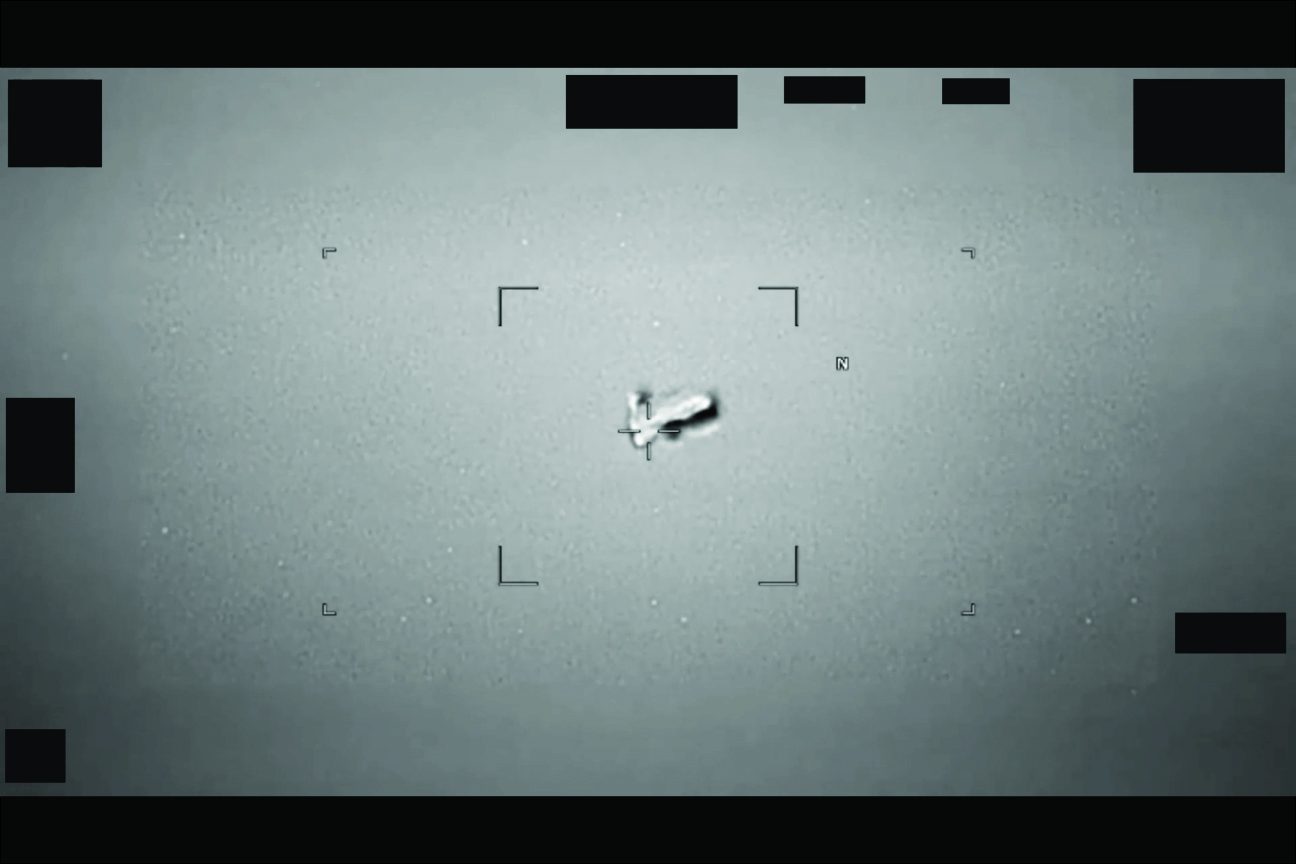
DoD sensor still of an unidentified object

The 2024 hearing treated AARO as the government's UAP clearinghouse. The corpus contains AARO's own Western US briefing: orange orbs ~12–18 m across launching smaller red orbs, seen by three independent teams of federal agents at a weapons test range, and shows USCENTCOM ISR crews filing standardized UAP reports to AARO through normal chains of command, 2020–2024.

Corroborates the premise of the Nov 2024 hearing and Grusch's "there is an architecture." Source: PURSUE Tranche 1 · DoD.
Structural An agency Grusch named is a primary UAP source ODNI · ODNI-UAP-D1

Grusch testified that ODNI, DIA, and DoE hold significant UAP material. The corpus includes a first-person account from a senior US intelligence official describing a multi-sensor encounter, routed within the ODNI collection, the first primary-source ODNI UAP document in the public domain. This confirms the holder, not the contents of any "legacy program."

Consistent with Grusch's interagency-holding claim. Source: PURSUE Tranche 2 · ODNI.
Structural The compartmentalization is visible in the metadata FBI / DoD / CIA / ODNI routing

Grusch's central institutional claim was compartmentalized, cross-agency management with no single office holding the whole picture. The corpus spans seven agencies, and the same incident types recur across FBI, DoD, CIA, and ODNI file chains with no consolidated record. The structure he described is present; whether it conceals what he was told it conceals, the corpus does not say.

Structurally consistent; substance untested. Cross-referenced in The System.
Partial Graves' phenomenon-class is documented; Fravor's case is not USCENTCOM ISR MISREPs, 2020–24
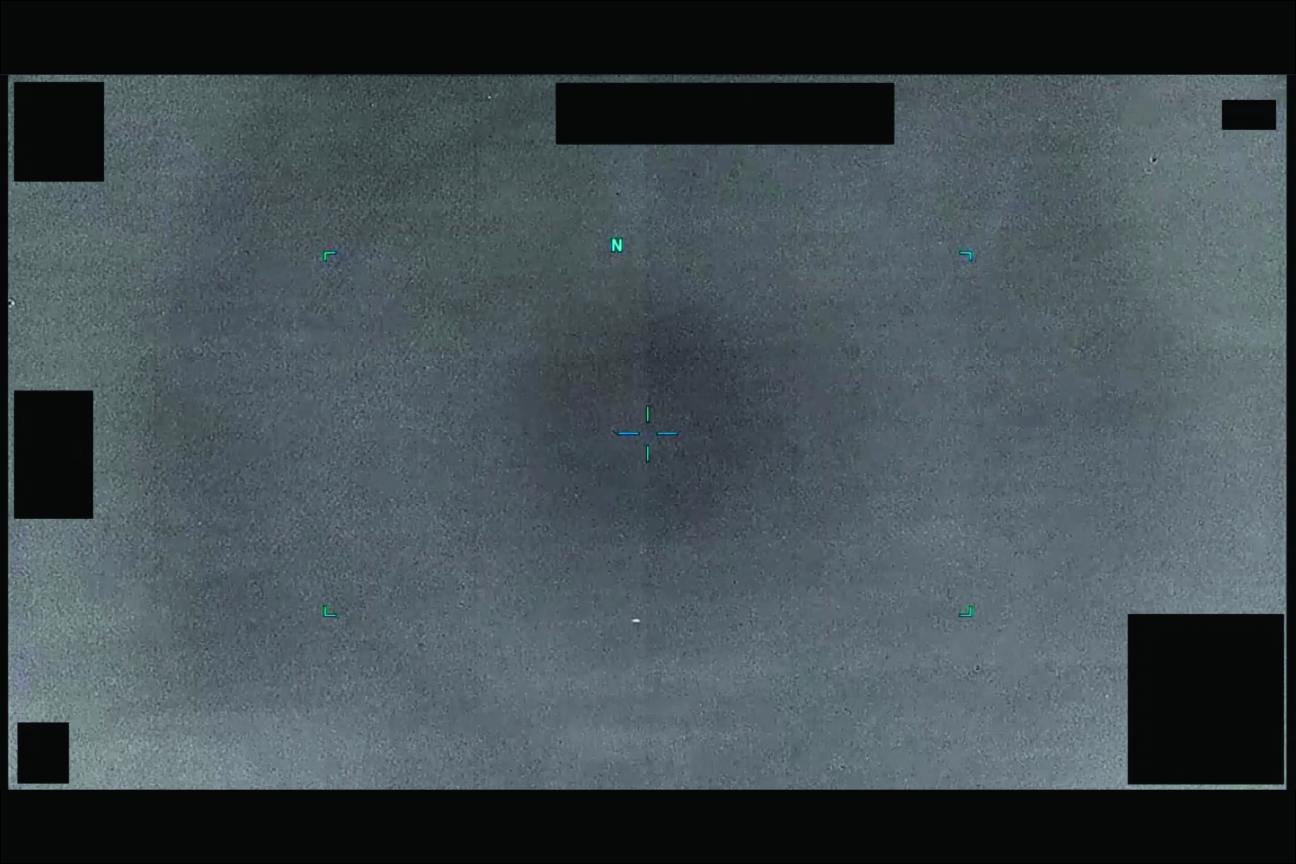
FLIR sensor still of an unidentified object

Ryan Graves testified to routine F/A-18 encounters with unexplained objects off the US coast. The corpus is full of exactly that class: standardized military sensor reports of cold, fast, shape-anomalous objects, 2020–2024. The limit: David Fravor's 2004 Nimitz "Tic Tac" is not in this corpus. The category is corroborated; that individual case is outside the record.

Phenomenon-class corroborated; named 2004 case absent. Source: PURSUE Tranche 1 · DoD.
Structural UAP-near-nuclear predates the hearings in the record Sandia 1949 · FBI Oak Ridge 1947
FBI declassified document

A recurring thread across all four hearings is UAP activity near sensitive installations. The corpus carries a 116-page Sandia Base correspondence file from 1949 (Sandia sits at Kirtland AFB) and an FBI file, "Flying Saucers Observed Over Oak Ridge Area," 1947. The pattern the testimony invokes is documented decades earlier. See New Leads, below.

Theme corroborated in the historical record. Source: PURSUE · DoD & FBI.
Contested A named program entered the paper trail, formally denied Immaculate Constellation · ODNI FOIA

The alleged unacknowledged program reached the 2024 hearing through journalist testimony. An ODNI-released document (FOIA DF-2025-00021) records the allegation and DoD's on-record denial: "The Department of Defense has no record, present or historical, of any type of SAP called 'IMMACULATE CONSTELLATION'." The legitimization is real; the claim is now in the record. Its truth is not established by its presence there.
Documented as a contested allegation, not a confirmed program. Source: ODNI release DF-2025-00021.
Part Three

Beyond the Corpus

The most dramatic testimony is, by the witnesses' own description, testimony about testimony. The documents are silent on it. Here is why that silence is honest rather than evasive.

A note on what we did not test

The bulk of the headline claims cannot be reached with this corpus, and we do not pretend otherwise. We do not enumerate every untestable claim, because the structure repeats: a witness reports, in good faith, what they were told by others with claimed direct knowledge. That is a description of the testimony's own methodology, not an accusation.

Crucially, the corpus does not contradict these claims either. No document in PURSUE affirmatively disproves a single hearing claim. We treat the corpus as silent, neither confirming nor refuting, the only defensible reading of a record that does not contain the material.

The clearest example is the testimony's own framing. Grusch was precise about his sourcing under oath:

"I was informed in the course of my official duties of a multi-decade UAP crash retrieval and reverse engineering program to which I was denied access to those additional read-ons when I requested it."

David Grusch, sworn testimony, House Oversight Committee, July 26, 2023

Informed of. Denied access to. Asked about recovered bodies, he answered that "biologics came with some of these recoveries" and described them as nonhuman, then immediately attributed the assessment to "people with direct knowledge on the program I talked to." This is not a knock on Grusch; it is the load-bearing structure of his testimony, and it places the substance one step beyond anything a document corpus can adjudicate. Elizondo's written testimony likewise rests on assertion of belief: "UAP are real," "the U.S. is in possession of UAP technologies", claims of conviction from a former program manager, not document citations.

What the corpus cannot speak to

The headline claims, held in honest suspension

Crash-retrieval and reverse-engineering programs; recovered "nonhuman biologics"; the internal records of AATIP, AAWSAP, Kona Blue, or any "legacy program"; US possession of off-world technology; Roswell and the Wilson-Davis memo. None are present in the 330 records. The corpus neither confirms nor refutes them. We leave them where the evidence leaves them: open.

Part Four

New Leads

The most valuable thing the hearings did, for this project, was point back at the documents. One file in the corpus connects the testimony directly to a case we already cover, and we read all 116 pages of it.

A thread worth pulling · DOW-UAP-D017

Sandia, 1949, the file that touches the Bennewitz ground

Most of this 116-page Department of Defense file is routine 1949 base-security correspondence: guard orders and alert plans for the nation's primary nuclear-weapons assembly point. But folded inside it is a sustained, multi-agency investigation into unexplained aerial phenomena over New Mexico's nuclear installations, run by the office that would, three decades later, run the Bennewitz operation from the same base.

Exhibit A · Los Alamos, 16 February 1949

When Edward Teller worked the problem

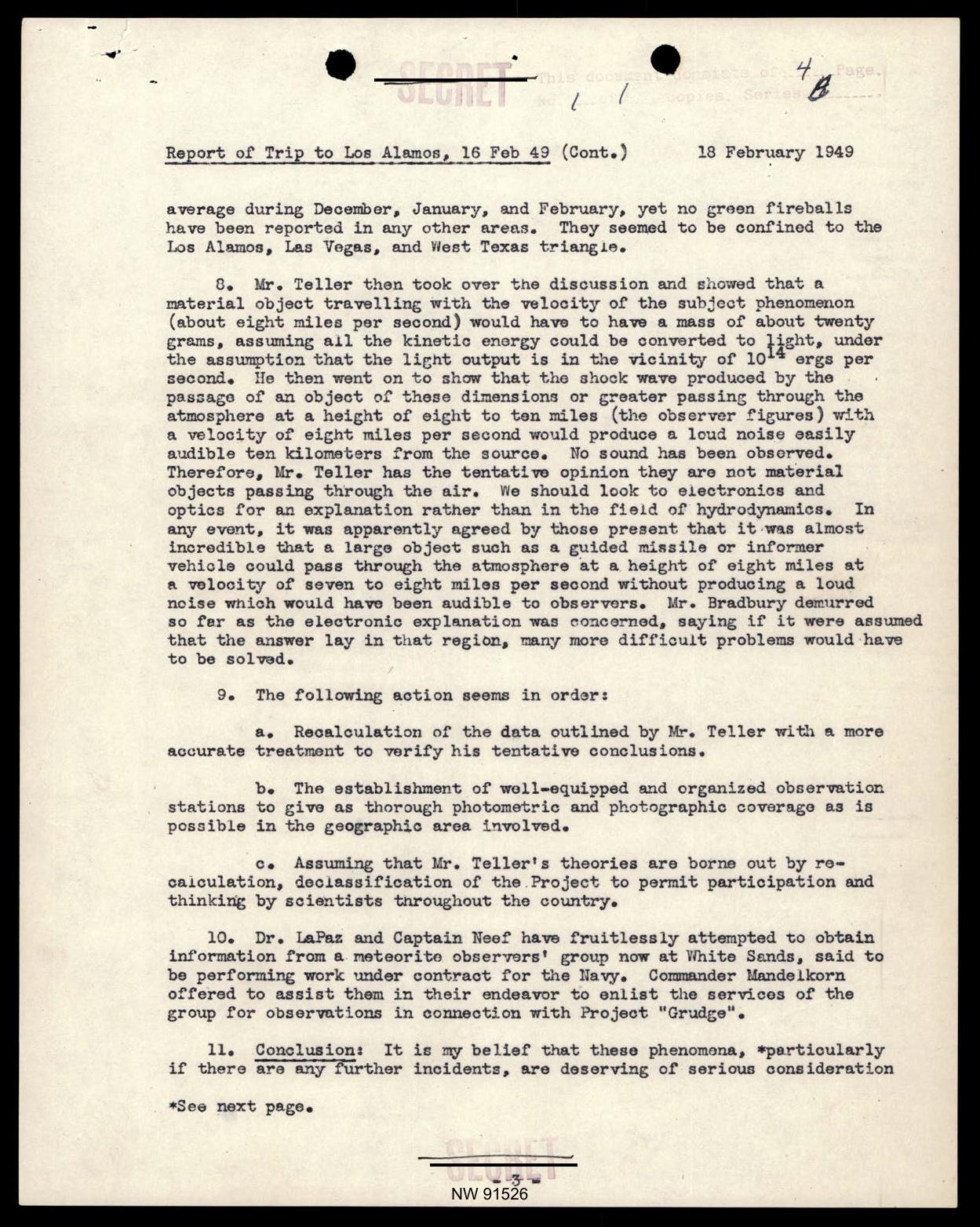
A trip report by Cdr. Richard S. Mandelkorn of Sandia Base records a conference convened at Los Alamos under the project name "Grudge," classified SECRET. The attendee list is the point.

Declassified 1949 SECRET memo: Report of Trip to Los Alamos, with Edward Teller's analysis of the green fireballs
DOW-UAP-D017, "Report of Trip to Los Alamos, 16 Feb 1949." Original classification SECRET (declassified). Primary source, PURSUE Tranche 2 · DoD.
Declassified · was SECRET

The men who built the bomb, asked to explain the lights

Present for Los Alamos: laboratory director Norris Bradbury (who succeeded Oppenheimer as LANL director), Fred Reines (who would receive the Nobel Prize in Physics in 1995 for discovering the neutrino), John Manley, and Edward Teller (co-designer of the hydrogen bomb), alongside senior Atomic Energy Commission officials, the Fourth Army, the Air Force, and Dr. Lincoln LaPaz of the University of New Mexico, the nation's foremost authority on meteoritics. This is not a room of mid-level investigators. This is the institutional core of the American nuclear weapons program, convened under a classified project name, specifically to evaluate unexplained aerial phenomena over its own installations. Working from the observed brightness, Teller calculated that a material object producing that much light at the reported speed would generate a shock wave audible ten kilometers away. None had been heard.

"Mr. Teller has the tentative opinion they are not material objects passing through the air. We should look to electronics and optics for an explanation rather than in the field of hydrodynamics."

His analysis pointed away from a foreign missile or aircraft, but produced no explanation. The meeting's standing conclusion was that the phenomenon was real and unexplained, and that its recurrence "in the vicinity of sensitive installations" was cause for concern.

Exhibit B · Datil, New Mexico · 24–25 February 1950

A photograph the government could not explain

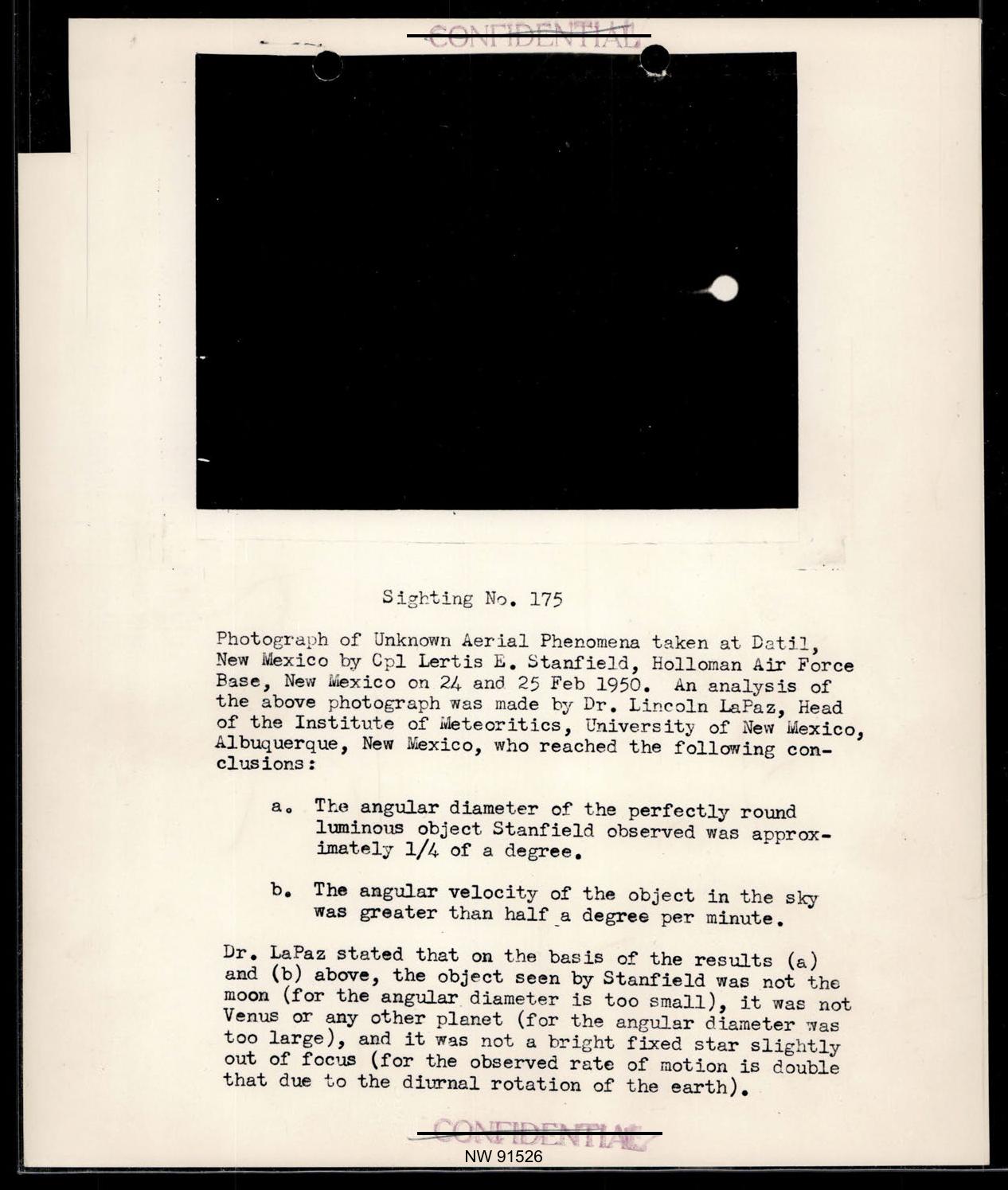
The file includes a photograph of an unknown luminous object, with a formal analysis appended.

Declassified 1950 file page: Sighting No. 175, photograph of an unknown aerial object at Datil, New Mexico, with Dr. LaPaz's analysis
DOW-UAP-D017, "Sighting No. 175," photograph taken by Cpl Lertis E. Stanfield, Holloman AFB. Primary source, PURSUE Tranche 2 · DoD.
Declassified · file exhibit

Not the moon, not a planet, not a star

Dr. Lincoln LaPaz, head of the Institute of Meteoritics at the University of New Mexico, measured the photographed object's angular diameter (about a quarter of a degree) and angular velocity (more than half a degree per minute). On those figures he ruled out the moon (too small), Venus or any planet (too large), and a fixed star out of focus (the motion was double the rate of the earth's rotation).

The file classifies its sightings into three types: green fireball, disc or variation, and probably meteoric. In the 17th District's own words: "In none of the reported incidents has any natural or man-made object been determined to be responsible."

The Through-Line

The same office, the same base, thirty years apart

Why this file matters to the rest of the site is not the green fireballs. It is who was investigating them, and where.

The investigation was run by the 17th District Office of Special Investigations at Kirtland Air Force Base. The OSI, the Air Force's investigative arm (established in 1948), is the direct institutional predecessor of AFOSI, the office that, beginning in 1980, ran the disinformation campaign against Paul Bennewitz from the same base, amid the same Sandia and Manzano nuclear-weapons installations. The 1949 distribution lists route the material across the AEC, the FBI's Albuquerque office, the Fourth Army, the Atomic Energy Security Service, and the Kirtland and Sandia commands, the same parallel, multi-agency handling David Grusch described to Congress as the management architecture, seventy-four years later.

What the file establishes, and what it does not

Documented institutional continuity, not a solved case

It establishes: a serious, scientifically-staffed government investigation of unexplained aerial phenomena clustered over nuclear installations in 1948–1950; that it could not explain them; that the office and base are the same ones later tied to the Bennewitz operation; and that the multi-agency routing pattern the 2023 hearing described existed in primary form in 1949.

It does not establish: what the green fireballs were. Teller's reasoning narrowed the field; it did not close it. The corpus carries the investigation, not its answer. As everywhere else on this site: the machine is documented, the cargo is not.

What the hearings actually changed

The record now contains the questions, under oath

The corpus cannot tell you whether the government holds a craft, a body, or a program with a code name. What the hearings established is different and verifiable: Congress placed specific agencies, programs, and sworn witnesses into the official record, and the institutional architecture those witnesses described, AARO, interagency compartmentalization, decades of nuclear-proximity reporting, is visible in the primary documents. The machine is on the record. The cargo is still a matter of testimony. That distinction is the whole of what we can honestly claim.