The Base
Sandia was the Manhattan Project's weapons-engineering arm, and it sat on the most over-watched ground in the country.
Sandia National Laboratories was the organization responsible for designing the non-nuclear components of atomic bombs and for physically assembling the weapons. Its home was Kirtland Air Force Base in Albuquerque, New Mexico, adjacent to the Manzano weapons-storage complex and an hour's drive from Los Alamos. By 1949 this corner of New Mexico held the densest concentration of nuclear-weapons infrastructure on Earth: the design lab, the assembly plant, the storage vaults, and the security apparatus built to watch all of it.
That apparatus is why the phenomenon here is so well documented. When unexplained objects began appearing over these installations in the late 1940s, they were not seen by isolated civilians. They were seen by trained security personnel, photographed, measured by physicists, and routed through a multi-agency intelligence chain, the AEC, the Fourth Army, the FBI's Albuquerque office, the Atomic Energy Security Service, and the Air Force's investigative arm. The result is a primary-source record of a government taking unexplained aerial phenomena seriously, at the highest level, over its own most sensitive ground.
The File
DOW-UAP-D017, a 189,000-character file, originally TOP SECRET, released in PURSUE Tranche 2.
The first primary Sandia document in the collection released with UAP content, DOW-UAP-D017 runs 116 pages. Most of it is guard orders and alert plans. But threaded through it is the 1948–1950 investigation: Edward Teller is named six times, Kirtland AFB four times, Los Alamos and the AEC throughout. Multiple passages describe anomalous aerial objects and "green fireball" sightings across the Southwest nuclear complex. The file sorts its sightings into three types, green fireball, disc or variation, and probably meteoric, and reaches a flat conclusion about the first two.
"In none of the reported incidents has any natural or man-made object been determined to be responsible."
The Investigation
Step through what the nuclear complex recorded, and how seriously it was taken. Each step is a document in the corpus.
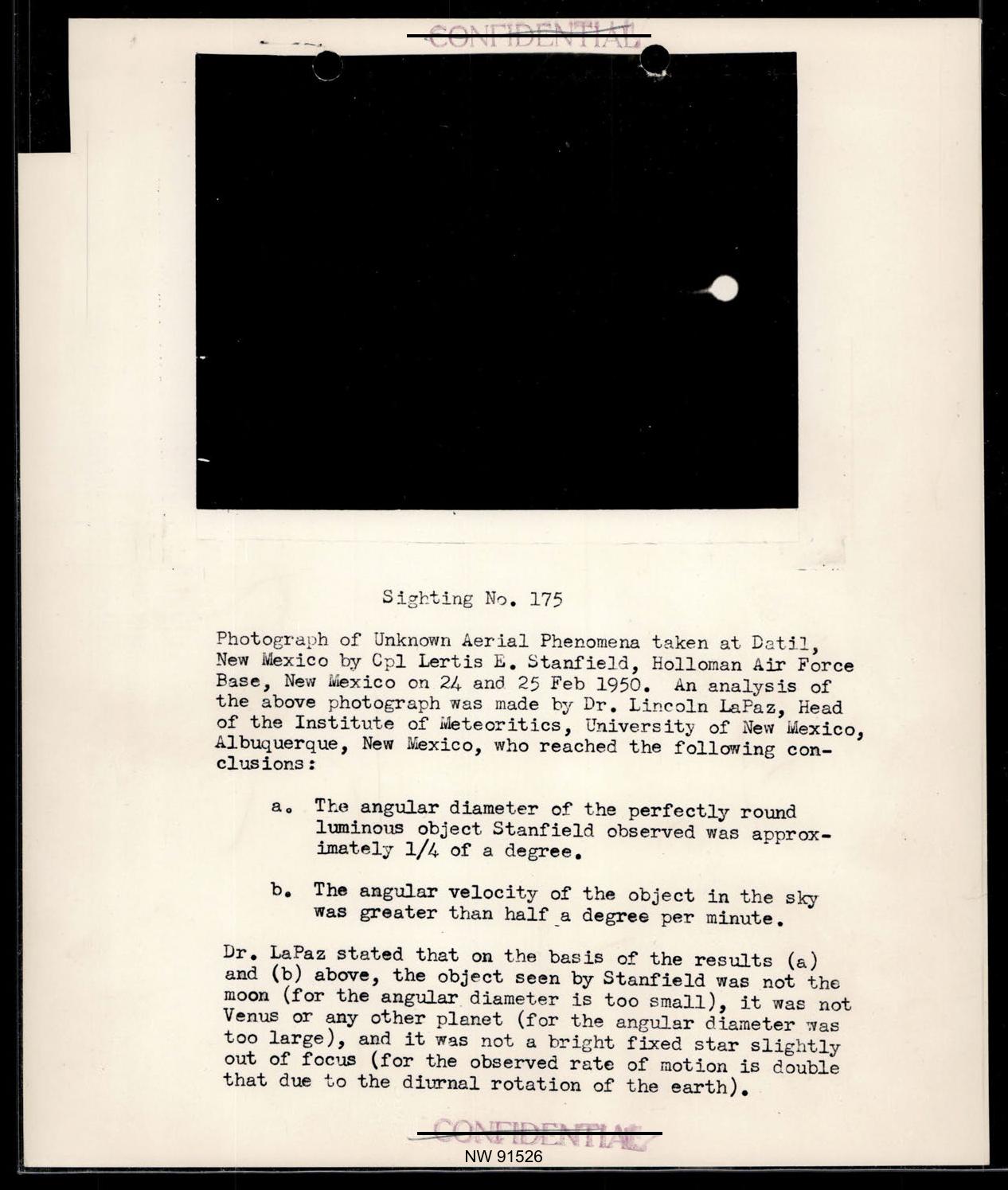
Not the moon, not a planet, not a star
Dr. Lincoln LaPaz, head of the Institute of Meteoritics at the University of New Mexico and the nation's foremost authority on meteoritics, measured the photographed object's angular diameter (about a quarter of a degree) and angular velocity (more than half a degree per minute). On those figures he ruled out the moon (too small), Venus or any planet (too large), and a fixed star out of focus (the motion was double the rate of the earth's rotation).
The Through-Line
Why this file matters to the rest of the site is not the green fireballs. It is who was investigating them, and where.
The investigation was run by the 17th District Office of Special Investigations at Kirtland Air Force Base. The OSI, the Air Force's investigative arm, established in 1948, is the direct institutional predecessor of AFOSI, the office that, beginning in 1980, ran the disinformation campaign against Paul Bennewitz from the same base, amid the same Sandia and Manzano nuclear-weapons installations.
The 1949 distribution lists route the material across the AEC, the FBI's Albuquerque office, the Fourth Army, the Atomic Energy Security Service, and the Kirtland and Sandia commands, the same parallel, multi-agency handling that David Grusch described to Congress as the management architecture, seventy-four years later.
Tranche 5 supplied the sentence that belongs beside OSI's. While the 17th District was compiling the New Mexico summary that concluded no natural or man-made object had been determined responsible, the Air Force had already reached the same finding at headquarters level, and had decided what to do about it. In a November 1948 study of roughly 180 incidents (DOW-UAP-D100), Air Materiel Command reported a residue with no everyday explanation and, in the same compilation, advised that it was “not considered advisable to present to the press information on those objects which we cannot yet identify.” The investigation on this page and the instruction not to discuss it are the same institution in the same eighteen months. That is the apparatus, visible in one place at its origin.
Documented institutional continuity, not a solved case
It establishes: a serious, scientifically-staffed government investigation of unexplained aerial phenomena clustered over nuclear installations in 1948–1950; that it could not explain them; that the office and base are the same ones later tied to the Bennewitz operation; and that the multi-agency routing pattern the 2023 hearing described existed in primary form in 1949.
It does not establish: what the green fireballs were. Teller's reasoning narrowed the field; it did not close it. The corpus carries the investigation, not its answer.
A note on the two halves of this page. Everything above about 1948–1950 is in the PURSUE release and can be checked in DOW-UAP-D017. The Bennewitz operation is not. The corpus holds no AFOSI material from the years that operation ran, and no Bennewitz or Doty file; that story rests on the public record, principally Greg Bishop's Project Beta and Mark Pilkington's Mirage Men, and is set out with its sources on The Deception Blueprint. What connects the two halves here is the organisation and the address, both of which are documented. The operation itself is attested from outside the archive.
The Echo
The protocol never closed. It is still on file inside the stockpile.
Sixty-six years after the Sandia file, the corpus carries a PANTEX "Unidentified Object Incident Report", from the plant where the United States physically assembles, disassembles, and maintains its nuclear warheads. The existence of a standing form for the event is the tell: an incident report implies a category, and a category implies recurrence. The same nuclear-adjacency pattern that LaPaz and Teller were measuring in 1949 has a filing protocol inside the modern weapons complex.
That pattern, where the sightings cluster, across which eras, is mapped on the Nuclear Proximity Map. And it is not only American: a 1973 CIA report logs a near-identical bright-green object over a Soviet nuclear site, on the other side of the Iron Curtain, where no US program could reach.