A senior U.S. intelligence official. A military helicopter. A listening post in the mountains. What follows is drawn from a classified first-person account released under the PURSUE program. Every timestamp is from the document. Every quote is verbatim.
The document describes positions, bearings, and geometry in enough detail to reconstruct the spatial layout. This is a schematic—not a map. Positions are approximate and relative. All call signs and identifiers are redacted per the source document.
Witness 1, a senior U.S. intelligence official, departs with Federal Partners 1 and 2 aboard a state partner helicopter, call sign [CALL SIGN 1]. They are heading into the mountains—the same mountains where personnel near a classified test facility reported hearing thuds and seeing orbs and lights.
"On 2025, at approximately 1700 hours, [WITNESS 1 (a senior US intelligence official)], [FEDERAL PARTNER 1] and [FEDERAL PARTNER 2], accompanied by [WITNESS 2 (a senior US intelligence official)] and pilots from [STATE PARTNER ORGANIZATION], departed the [OPERATIONS CENTER] to conduct a daytime aerial search of the [MOUNTAIN RANGE NAME] west of [SITE CODE NAME]."
Earlier that day, the same office completed a successful test of [REDACTED] at [SITE CODE NAME] on [FACILITY]. The connection, if any, is not addressed in the document.
"[CALL SIGN 1] spotted a cave entrance ([COORDINATES]) and conducted a short orbit of the location."
The search area has been redacted throughout. A cave entrance near a classified test facility in a mountain range, investigated from the air.
The helicopter lands west of the mountains. Witness 2 and Federal Partner 3 personnel are dropped off on the ground. The helicopter heads to [SITE CODE NAME] to refuel. A second helicopter briefly lands at the same site to await refueling, then lifts off and returns to base.
Witness 2 and their ground team will become part of the LP/OP network—the forward observation team that, hours later, will be the first to detect what comes next.
Refueled, Call Sign 1 lifts off from [SITE CODE NAME] and heads toward debris spotted by the Listening Post. The LP/OP team is four miles east of [SITE CODE NAME] in the mountains, using Forward Looking Infrared (FLIR) and Night Vision Goggles (NVG). They have something.
"[CALL SIGN 1] headed toward debris spotted by the Listening Post/Observation Post—[FEDERAL PARTNER 4] personnel using Forward Looking Infrared (FLIR) and Night Vision Goggles (NVG)—position ([COORDINATES]) located approximately four miles east of [SITE CODE NAME] in the mountains."
The helicopter searches the original location with NVGs and spotlight—negative results. Then, minutes later:
"[CALL SIGN 1] departed the search location to return to base and received notification from LP/OP that—had hits bearing—4 miles out from their location. The JOC then provided coordinates."
The helicopter arrives at the coordinates. The pilots spot a possible aircraft on the horizon—moving west. LP/OP confirms the sighting. Then LP/OP reports something else entirely:
"LP/OP confirmed the sighting then relayed they spotted an orb under FLIR and described as 'super-hot' hovering at ground level before heading [bearing] from LP/OP. LP/OP reported the orb was heading east and then south at a high rate of speed and then broke into two objects."
LP/OP directs Call Sign 1 south to intercept.
"JOC reported five [MILITARY AIRCRAFT] from [REDACTED] were in the airspace conducting a training mission."
Five military aircraft are now in the same airspace. They will be called in to assist. By the end of the night, the document will record that the orbs appeared to pursue them.
The helicopter searches the intercept coordinates with FLIR, NVG, and naked eye. Nothing visible. Then:
"LP/OP reported the orb gained elevation, came within ten feet of [CALL SIGN 1] and then headed east to [REDACTED]."
The object the LP/OP team tracked to within 10 feet of the helicopter was not visible to the crew onboard—neither on the helicopter's FLIR nor to the naked eye. Only the ground team's thermal imager caught it at closest approach. Call Sign 1 gives chase but cannot match speed. The co-pilot, looking through NVGs, watches something emerge from the split objects and accelerate away in a third direction.
The helicopter holds position awaiting instructions. Then Witness 1—naked eye—and the pilots through NVGs see something to the west:
"[CALL SIGN 1]—[WITNESS 1] (naked eye) and the pilots (NVG) spotting a swarm of lights—too many to count—moving in all directions but generally located west of [REDACTED] and headed south."
Call Sign 1 loses visual of the swarm.
In the same time window that the swarm disappears, something new appears—directly beside the helicopter:
"[WITNESS 1] (naked eye) and the pilots (NVG) spotted two large orbs appear in close proximity to [CALL SIGN 1] to the west and above the rotor disk. From the naked eye perspective, the two orbs appeared to flare up and remain stationary side by side. They appeared to be oval shaped, orange in color with a white or yellow center and emitting light in all directions. After a few seconds, a third orb flared up below the two, and then another one below that one until there were four or five in total below the original two. After a few seconds the orbs began to flare down in reverse order while appearing to be stationary until visual was lost."
"Spotted four or five orbs (similar to the orbs in close proximity to the helicopter) appear to the west over the mountains above the [MILITARY AIRCRAFT]. The orbs flared up one at a time in a horizontal formation and after approximately ten to fifteen seconds, flared down in the opposite order and lost visual."
The same formation pattern. This time positioned directly above the military aircraft that had been called in to assist—the aircraft that, by the end of the document, will be described as being pursued by the orbs.
"Spotted a similar orb formation to the east in the direction of [NEARBY TOWN NAME]. The orbs flared up one at a time in a horizontal formation and after approximately ten to fifteen seconds, flared down in the opposite order and lost visual."
First to the west. Now to the east. The helicopter is between them.
"Spotted a similar orb flare up west of [SITE CODE NAME] over the mountain. After several seconds the orb flared down and lost visual."
Something different. Not a horizontal line this time:
"Spotted a swarm of lights moving in all directions west of [REDACTED] with three distinct orbs in a triangle formation. After several seconds the orbs flared down and lost visual."
"Spotted five to six orbs flare up IVO [LOCAL TOWN] (east of [SITE CODE NAME]). The orbs flared up one at a time in a horizontal formation and after approximately ten seconds, flared down in the opposite order and lost visual."
The military aircraft are descending to land. The orbs appear directly above them:
"Spotted four orbs flare up over the [MILITARY AIRCRAFT] as they descended to land. The orbs flared up one at a time in a horizontal formation and after approximately ten seconds, flared down in the opposite order and lost visual."
The same formation behavior observed seven separate times, from at least three distinct compass bearings, over a 30-minute window. Each time: appear in sequence, hold, disappear in reverse.
"Low on fuel, [CALL SIGN 1] returned to the [OPERATIONS CENTER]."
At approximately 2320Z, passing another federal partner aircraft heading northbound toward [SITE CODE NAME] to continue the search.
After RTB, Witness 1 provided the following statements in debrief. All are verbatim from the USPER Statement:
"The orbs appeared to break off from [Call Sign 1] and pursue the [Military Aircraft]."
"At one point we had uncountable lights that were moving around the operational area simultaneously."
"The object split into two—a piece broke off and accelerated in a third direction."
The document contains no official explanation for any of the events it describes. The author is identified only as a senior U.S. Intelligence Community official. All names are redacted.
The location is classified. The date is partially redacted. The names of every participant—the senior intelligence officials, the federal partners, the state partner pilots, the LP/OP ground team—are all removed. [SITE CODE NAME] is not named anywhere in the declassified version.
What is named: the timeline. The instruments. The behaviors. The sequence.
Seven separate orb formations over 30 minutes, from at least three compass bearings, each following the same pattern—appear one at a time, hold, disappear in reverse—while a swarm of uncountable moving lights surrounds the operational area. An object that approached within 10 feet of a military helicopter, split in two, and produced a third object that accelerated away in a third direction. Military aircraft called in to assist, which the orbs then appeared to pursue.
The document was classified SECRET//NOFORN. It was released under the PURSUE program in 2026 alongside 223 other records. No official explanation has been offered for any of the events it describes.
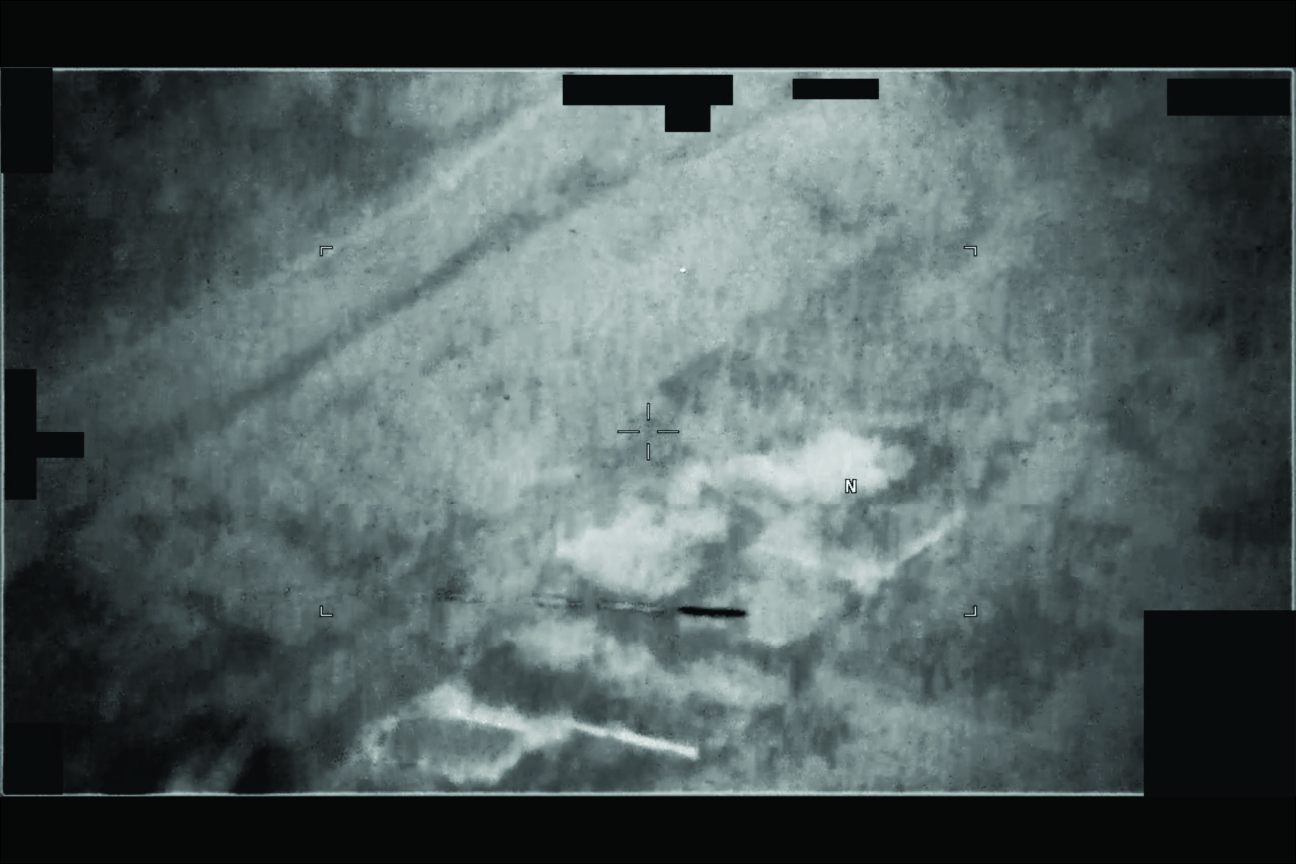
The LP/OP ground team tracked the objects on a Forward Looking Infrared sensor throughout the mission. No imagery from that night has been declassified. But other PURSUE records contain FLIR captures from separate documented encounters.
Forward Looking Infrared cameras detect thermal radiation rather than visible light. Every object emits heat in proportion to its temperature. On a black-hot sensor setting, the coldest objects appear white and the warmest appear black. On white-hot, this is reversed.
Anomalous objects in PURSUE records frequently appear as intensely bright signatures on black-hot settings, indicating either extreme cold or a thermal profile that does not match conventional aircraft. In several cases, objects are clearly resolved at altitude despite no visible light source, no exhaust plume, and no acoustic signature at the sensor platform's position.
FLIR is considered one of the most reliable sensor modalities for UAP documentation because it captures what is physically there rather than what is visible to the eye. An object that appears invisible at night can still produce a clear FLIR signature.
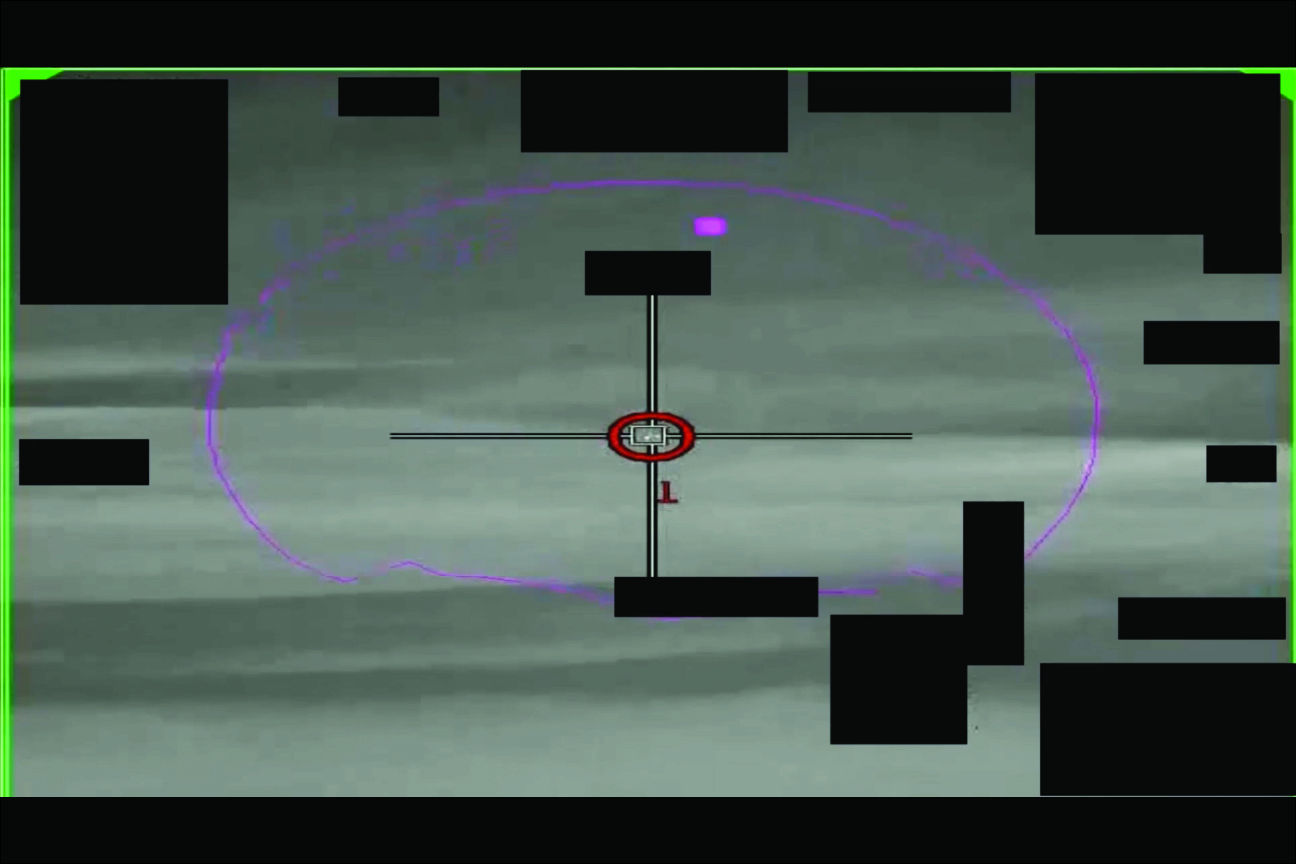
Active tracking engagement. Sensor display shows a targeting ellipse and acquisition circle locked onto a thermally anomalous object. The object's thermal signature is distinct from the surrounding environment. One of the most operationally detailed captures in the corpus.
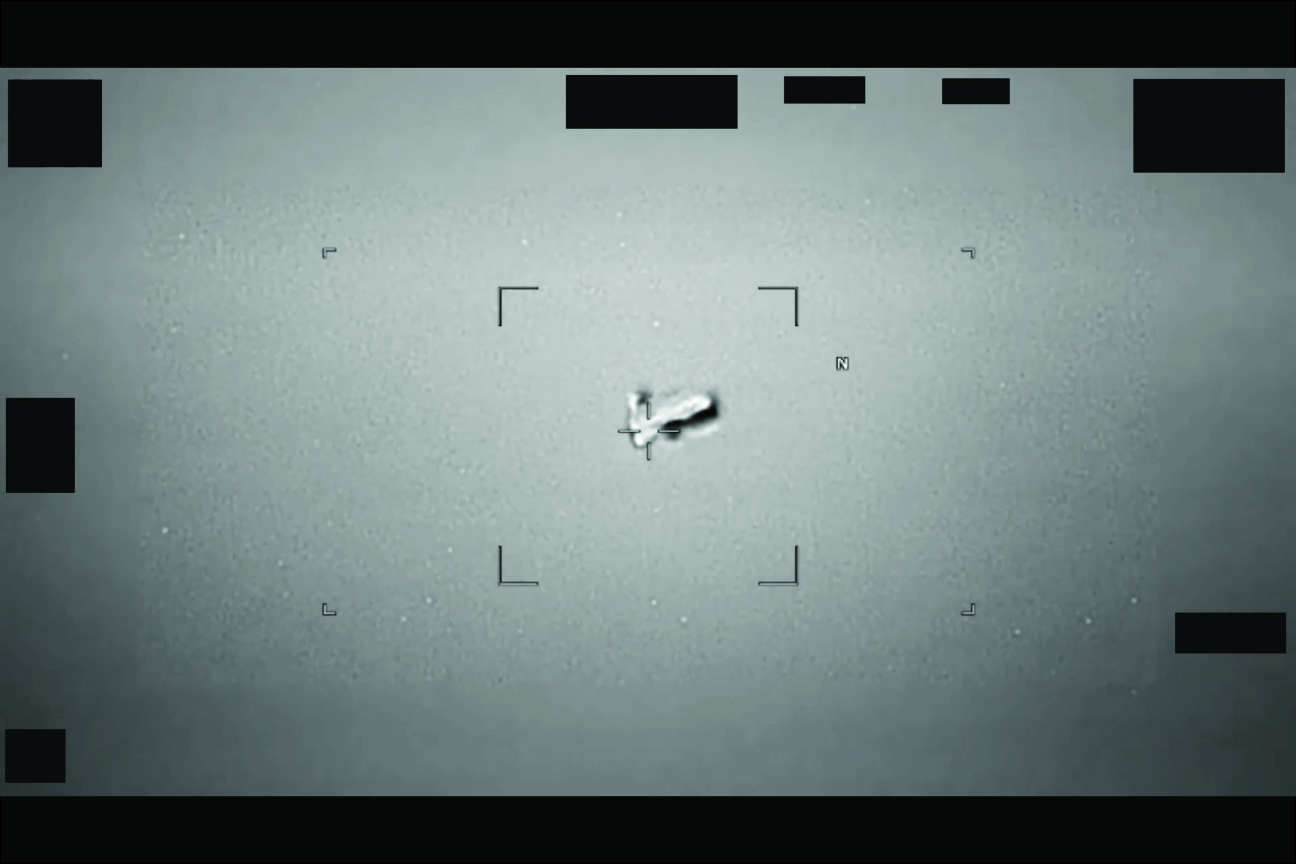
A bright, oblong white-hot object centered precisely on sensor crosshairs. The object's thermal output is significantly above ambient. No wings, rotors, or exhaust plume are visible. Shape is consistent with "elongated orb" descriptions across multiple PURSUE reports.
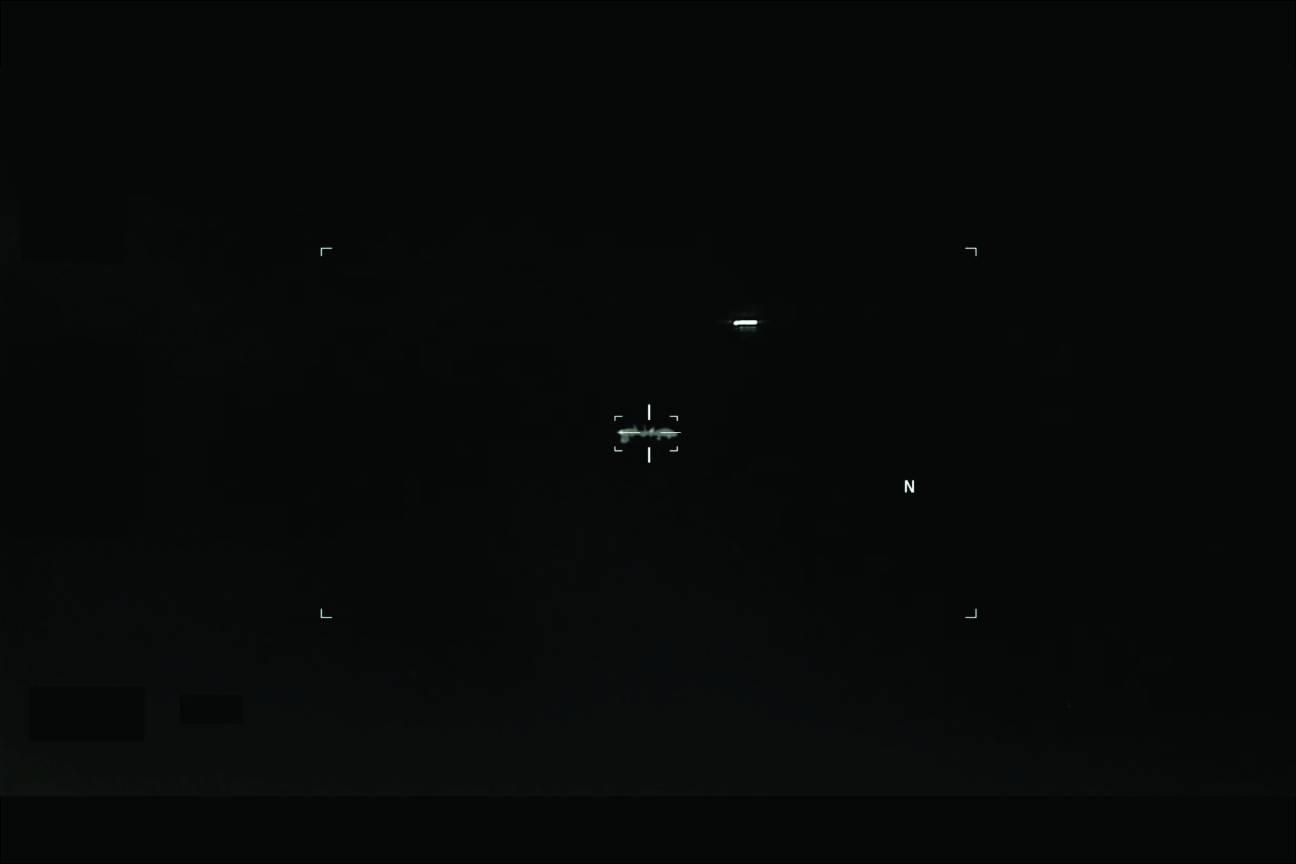
Against a pure black night sky, a small elongated bright object. The contrast between the object and total darkness is stark. No infrared countermeasure signature. Captured by Army ISR assets in a domestic airspace incident documented in Tranche 1.
An elongated object tracked against a broken cloud layer. The object's thermal signature holds consistent through changes in background temperature as it crosses in front of cloud formations, indicating the heat source is on the object itself rather than reflected.
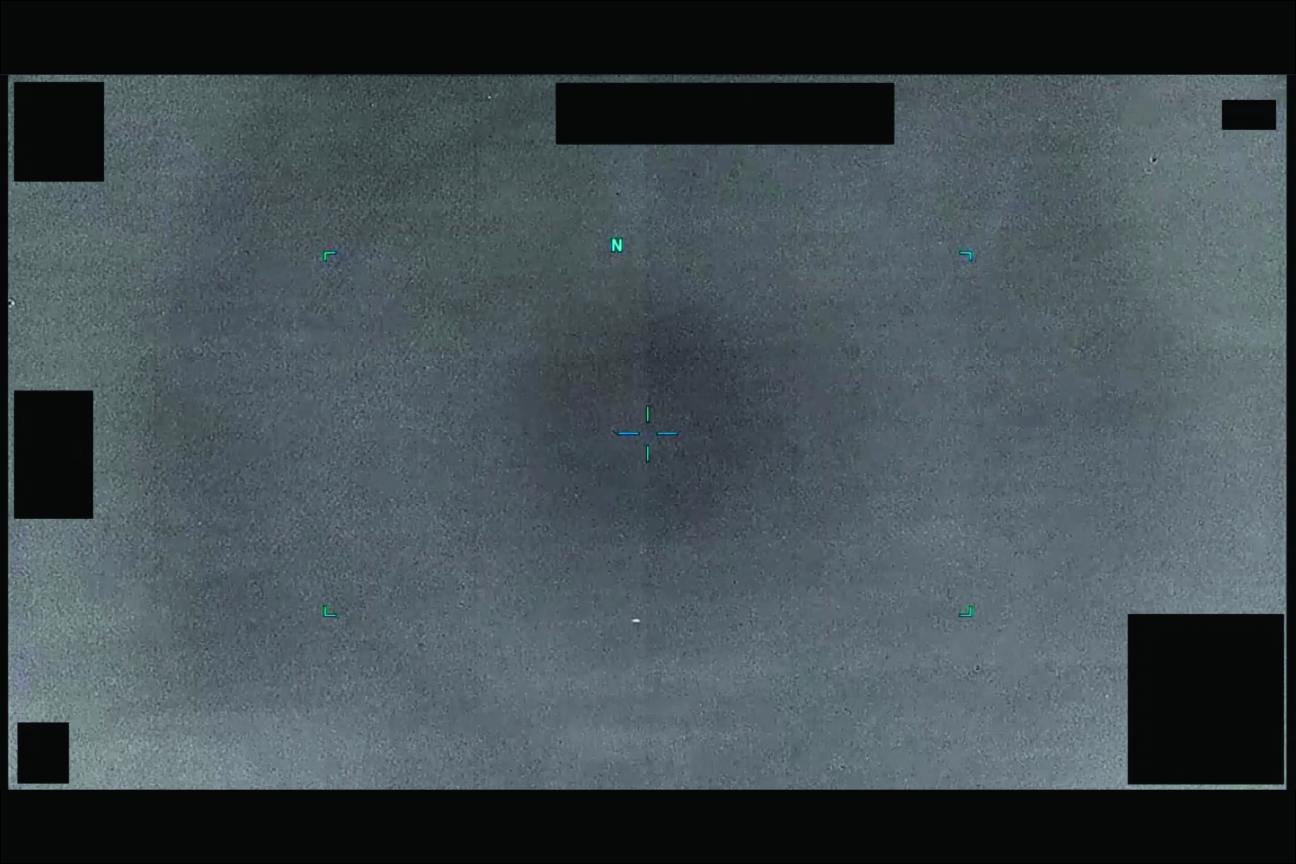
A nearly empty frame with a faint, barely-resolved thermal point in the upper field. Included deliberately: this illustrates how difficult detection actually is at operational distances. Most FLIR UAP contacts begin looking exactly like this.
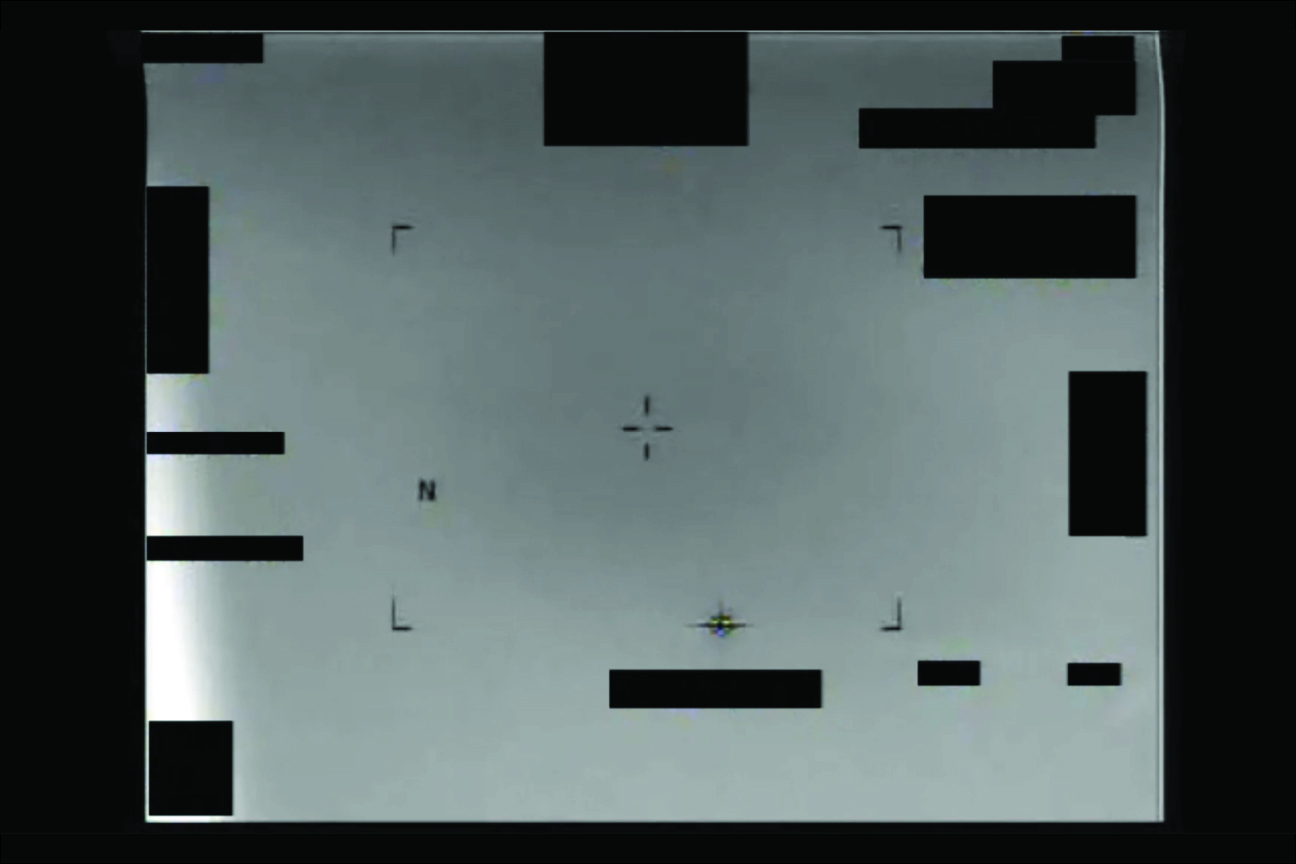
A small thermally anomalous object with significant portions of the surrounding sensor data redacted before release. The redaction pattern itself is notable. One of the oldest FLIR captures in the corpus.