The Event
The flagship case of the entire PURSUE release, and the reason it leads the government's own database.
When the Department of War published its first PURSUE tranche on May 8, 2026, the case placed first, "Incident 1 of 4" in the official database, was not a Navy FLIR clip or a Cold War file. It was a briefing deck about six federal law enforcement special agents, identified only as USPER1 through USPER6, who had watched something happen in the sky near a sensitive national security site in the western United States.
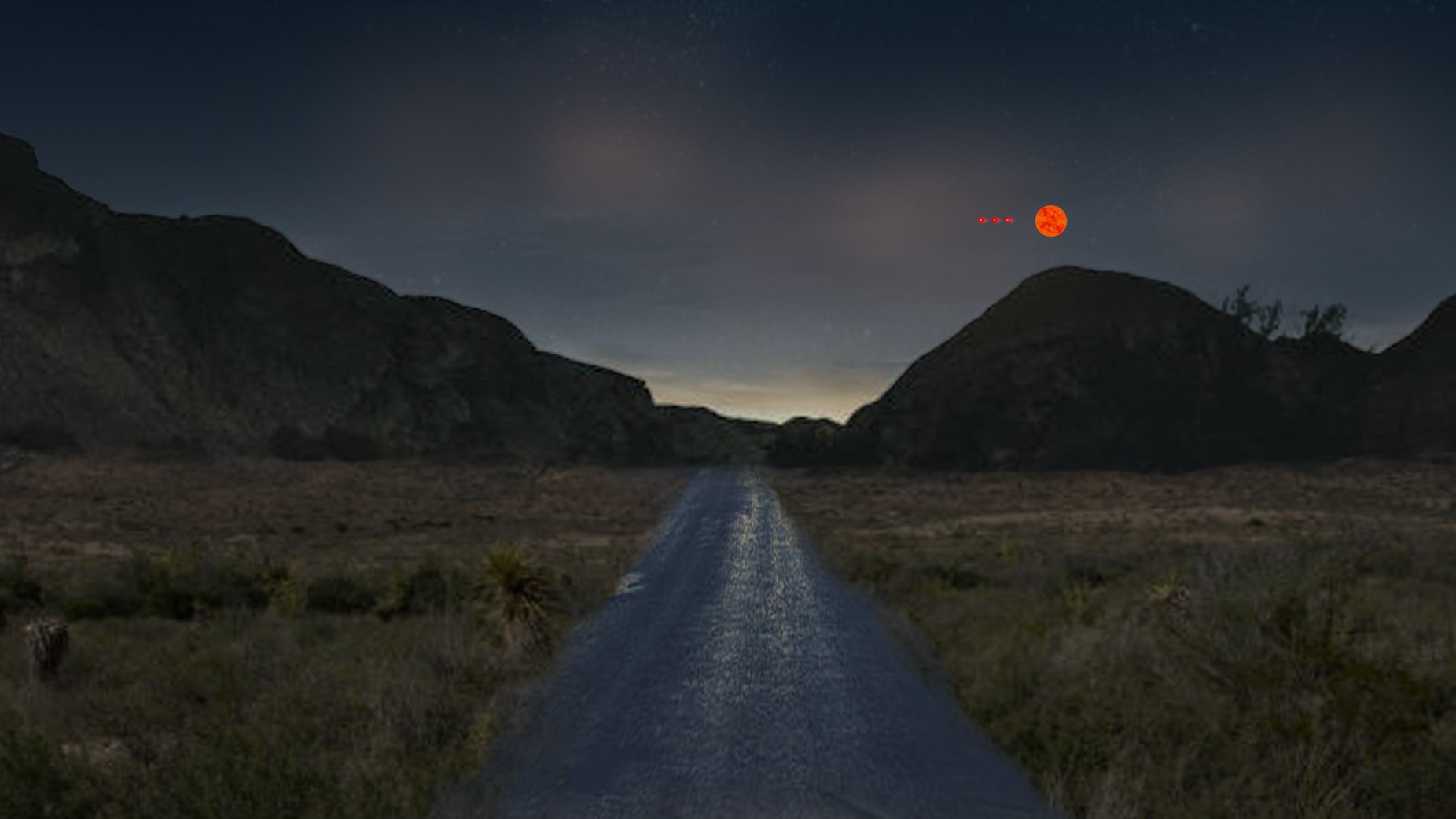
The agents were on duty, in three teams of two, at separate locations with different vantage points. Over two dusk periods they independently reported the same repeating sequence: an orange orb appears, visible for one or two seconds; it emits or launches smaller red orbs, in groups of two to four, three by general consensus; the orange orb disappears. The sequence repeated at least five times. The red orbs moved away horizontally, in a couple of instances angling up or swooping down, and in at least one report a red orb remained stationary above a ridgeline for several hours. Every account describes the phenomena as silent.
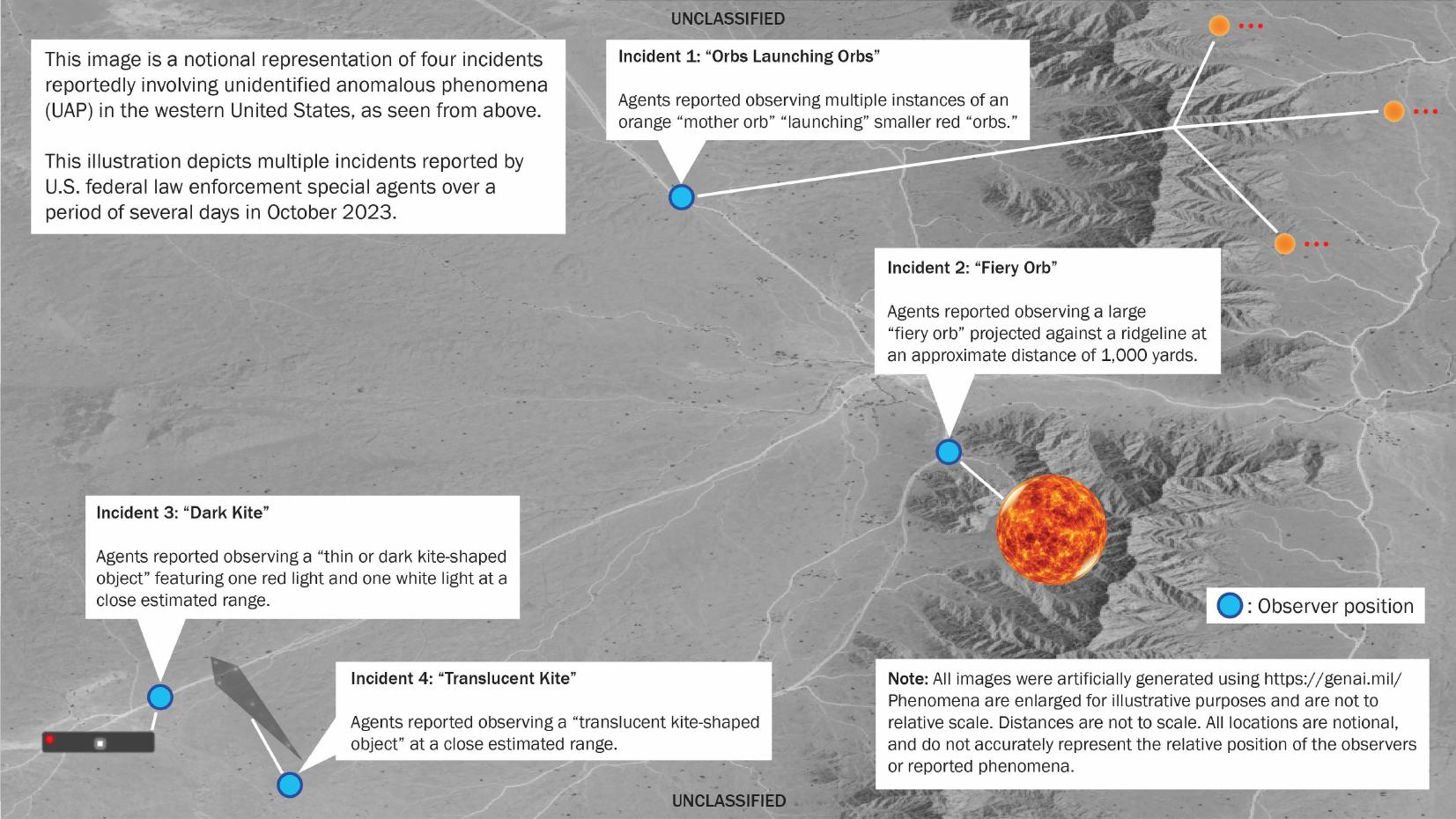
The case built across the release cycle. Tranche 1 delivered the briefing deck. Tranche 3, on June 12, 2026, delivered the primary record: AARO's formal Unresolved Case Analysis Update, a notional map of the observer geometry, the agents' five first-person narratives, and ten FBI digital renderings reconstructing individual moments. Eighteen documents at that point, already more than any other single incident in the release. Tranche 5 then added eight more for the 2026 continuation, bringing the cluster to twenty-six.
The Four Sightings
The case file is not one anomaly. The briefing deck describes four, sharing a location and a pattern of behavior.
Orbs Launching Orbs
The signature event. Orange "mother" orbs appear for one to two seconds, launch two to four red orbs, and vanish. Witnessed at least five times by multiple teams from different vantage points. Whether one orange orb returned repeatedly or several took turns, the record cannot say.
"orange 'orbs' in the sky emit/launch smaller red 'orbs' in groups of two to four… stated to have occurred at least five times."
The Large, Fiery Orb
USPER5 and USPER6 watch a glowing orange orb perched beside a rock pinnacle for about a minute, silent, with what one agent thought might be "a small spindle" connecting it to the rock. AARO's later measurements put it roughly 1,050 meters out and 12 to 18 meters across.
"seemed to be hovering with zero resistance or movement, or to be suspended…"
The Dark Kite
What looked like a car's lights in a restricted zone, pursued by agents, leaves the road and moves laterally over the desert at 15 to 20 mph without changing orientation or height. Through night vision, after its lights cut out: a "very thin line," roughly four feet wide, that rose while staying flat.
"an ill defined, dark kite shape that had some rounded width to the sides."
The Transparent Kite
Near the same spot, a kite-shaped object with the same lighting pattern floats slowly with the wind, six meters up. Through night vision an agent could faintly see stars through it. A spotlight beam swept across the area later stopped mid-air "on nothing in particular," then projected normally again.
"my beam went from shining far into the distance to stopping about 50 yards away on nothing in particular…"
The Witnesses
Tranche 3 released the agents' five first-person narratives. The language is theirs, hedges included.
A well-defined circle of light on a hillside, about 20 feet across, "like a swirly pattern of bright lava." The agent puts a laser rangefinder on the hillside: roughly 1,100 meters. Later, an orange ball releases three evenly spaced red lights.
The only sighting in the case with an instrument-measured distance attached to it.
A bright orb with a smaller red orb inside it "expelled three or four red lights" that accelerated "instantly… with perfect, smooth coordination" into a horizontal formation, a process repeated about five times. The agent reaches for an image and immediately fences it: the sequence resembled "the opening and closing of a portal," offered explicitly as analogy, not claim.
An orange orb alternating clear and orange every two to three seconds expels red orbs "like grapes being expelled from a basketball." Four red lights then hover "in a square over each corner of the airfield." The account also logs a ground vehicle flashing its headlights, the ordinary noted alongside the anomalous.
Objects "hatched" from larger orange lights, so many the agent lost count after five, and a static horizontal line of nine evenly spaced lights held for more than thirty seconds. This is also the most self-skeptical account: the same witness reports next-day observations they attribute to contrails and Starlink, and is visibly more inclined toward mundane readings.
A timestamped field log, vehicles and license plates included. An orange light "hovering with zero resistance" over a ridge peak releases two red orbs; everything is gone in about ten seconds, followed by a white flash. The most procedurally disciplined narrative in the set, written the way agents are trained to log surveillance.
Six agents reported; five narratives were released. The accounts agree on the sequence, the colors, the counts, and the silence, and they disagree in exactly the way independent witnesses do, on analogies, emphasis, and how much doubt to carry. None of them collected video. They were working, not skywatching.
The Analysis
DOW-UAP-D077, June 5, 2026: AARO cross-correlates the narratives against flight logs, radar, ADS-B, and spatial data, then walks its hypothesis ladder in public.
Two and a half years after the event, AARO published its Unresolved Case Analysis Update. It is the most methodologically transparent document in the release: every candidate explanation is named, weighed, and given a disposition. Before weighing, AARO addresses the obvious objection itself, that this is narrative testimony from low-light conditions with no technical data, and answers it with three factors: the reports' close alignment with other western U.S. incidents, the agents' professional familiarity with the operational environment and military systems, and the consistency of six accounts from multiple viewing angles.
Aircraft were present but too high for exhaust to read as orange orbs; inconsistent with silence, loitering, and launching behavior.
A red orb reportedly persisted for several hours, past the battery and endurance limits of typical military and commercial multi-rotor systems.
Aircraft in the area deployed infrared countermeasure flares in a standard exercise, and position, direction, and timing align with radar and ADS-B for roughly 60 percent of the activity. For the remaining 40 percent, no known aircraft were in the observers' line of sight, and one stationary multi-hour orb is physically incompatible with any known flare.
Individual characteristics align with certain U.S. military technologies, but records are inconclusive on whether those technologies were present, and no single system accounts for everything reported.
The reported kinematics diverge too far from known adversary systems, per AARO's consultation with the Intelligence Community.
Weather was wrong for ball lightning or sprites; clear conditions argue against refractive effects; diverse viewing angles and multi-hour persistence rule against celestial bodies, meteors, and satellite flares.
AARO's exclusion-based hypothesis for up to 40 percent of the phenomena, stated with its own caveat: based solely on testimony and the elimination of rivals, unsubstantiated by technical data or physical evidence.
"Approximately 40 percent of the reported phenomena lack a plausible explanation after first stage analysis and thus remain unresolved."
The Skeptic's Reading
The case is only as honest as the doubts it keeps attached. These are the real ones.
There is no video, no photograph, no sensor track of the orbs themselves. The entire anomalous residue rests on narrative testimony gathered from trained observers in low light, and human estimation of range, size, and speed under those conditions is poor. AARO says this itself before setting it aside.
Sixty percent of the event was probably flares. The agents insisted the phenomena did not look like flares, but AARO notes the specific countermeasure flares in use that night differ visually from the standard illumination flares agents would know. If the majority of the sequence was flares, the remainder inherits some probability of being flares seen under rarer geometry, gaps in radar coverage are not proof of absence.
The Blue Force hypothesis did not close. AARO found U.S. technologies whose characteristics align with parts of the reports and could not confirm or exclude their presence. A classified American system being tested near a sensitive site, imperfectly deconflicted, remains a live mundane explanation, and it is the one hypothesis whose evidence would be deliberately hidden from the analysts themselves.
What the skeptical reading cannot easily absorb is the stationary red orb: hours of persistence is incompatible with flares, batteries, and celestial motion at once. It is also the single strangest claim in the case, resting on the same unaided eyes as everything else. That tension, the best-evidenced anomaly being the least instrumented, is the honest center of this file, and it is why the case is rated the way it is rather than higher.
2026: The Watch
Four FBI interviews released in August 2026 put federal personnel back in the same western landscape, three years on. Nothing about the phenomenology is new. Everything about the posture is.
The government is now looking on purpose. In the 2023 case, every sighting begins with someone happening to glance up. The first 2026 interview does not. An agent is alerted to a radio-frequency detection at 10,000 feet above sea level, lasting five to ten seconds, with an unknown bearing. A follow-up communication narrows it: observe on bearing 58 degrees. Within a few minutes he puts a hand-held thermal optic on that bearing and finds a black object, then a second beside it, both travelling together. He films them for five to ten minutes.
That is a detection chain: a sensor cue, a directed acquisition, a confirmation, and released footage. It is the first record in this corpus that documents one. Whatever it implies about the phenomena, it tells you something definite about the institution — somewhere in the western United States there is equipment listening, and people whose job it is to go and look when it hears something.
The witnesses are running controls. The following night the same agent sees another object in the same sector on a similar heading, two ridge lines further west. Rather than guess at its size, he deliberately films a U.S. Army Black Hawk passing through the same airspace, to establish a thermal and visual reference for scale and flight characteristics. He then judges the unidentified object at roughly half the helicopter's size, and writes plainly that this is an estimate only, and that he could not determine its make, model, propulsion, or even whether it was fixed-wing, rotary-wing or unmanned. A witness building his own calibration baseline, and stating the limits of it, is not a common thing in this record.
The signature is the same, and it still resists the instruments. Two other witnesses, interviewed separately and one of them by telephone, describe roughly five hours of dull red lights along a ridgeline to their west, then directly overhead, then close: two approaching within about four hundred metres, one apparently six feet off the ground, and one whose glow moved along a dry wash a hundred metres behind them. Six to ten lights appeared overhead at one point, seemed to "sync up" with a light already being tracked, and left east-southeast together; one dropped an estimated thousand feet and vanished. Red lights, in groups, coordinated, silent. That is the 2023 signature, three years later, from different people.
They could see the objects with the naked eye and through night optical devices. They could not acquire them on thermal at all.
And one claim that does not fit anywhere else. At around one in the morning, one of the witnesses checked his watch against his phone. The watch, a mechanical analog piece he had owned five years and which had never drifted more than sixty to ninety seconds, was roughly twenty-five minutes fast. His companion's digital watch, both phones, and the vehicle's clock all agreed with each other. It had been accurate at ten o'clock. He deliberately left it unadjusted for twenty-four hours: it kept correct time from then on, and kept the offset.
It is a single self-reported observation with memory-estimated times, and a mechanical watch is a mechanical watch. It is also the most specific physical-effect claim in this corpus, and it comes with its own control group sitting in the same vehicle. Both of those things are true and neither cancels the other.
The two men remarked to each other afterwards that, given their backgrounds, they found it strange they had felt no fear.
What this does and does not establish. It does not make the 2023 event stronger. The 2026 records are separate observations by different people, and they are rated on their own evidence. What they do is remove a particular skeptical read of the original case — that it was a two-night anomaly at one location, of the kind a cluster of flares or an unusual exercise could produce and then never repeat. Something is still happening in that landscape, federal personnel are still reporting it, and the government has apparently pointed equipment at it.
The Documents
All 26 records in the cluster. Read each scan here, or open its full analysis in the corpus.